

Mandates and Mission are Apostolic
And biblical: Acts 15

For your information, if you didn’t already know, it is a waste of your time to debate the SSPX Consecrations with anyone who either supported them or considers the Vatican’s response “dubious”. Nothing will convince, and one has to have a modicum of both humility and learning to know that the “counter-arguments” are simply nonsense.
The point of this article is very different: it is to show - against a growing trad-tide that would have you believe the contrary (and is thus, as I will demonstrate, contrary to The Tradition) - that mandates and mission are established at the First Council of Jerusalem, become more explicit through the centuries, have been around ever since, and are in the first printed Roman Pontifical, and therefore, without any ambiguity: mandates and mission, from legitimate superiors who also rule the Church Catholic and the local diocese, are part of the Tradition and cannot be removed from Catholic life without a consequent “change of dogma”. Since Traditionalists have putatively been against any change of dogma, at least since the days of Dietrich von Hildebrand, we have to consider this more profoundly.
First, we set the argument in its proper place: in Acts of the Apostles 15:24-25, we read: “Forasmuch as we have heard that some going out from us have troubled you with words, subverting your souls, to whom we gave no commandment [mandavimus: mandatum]: It hath seemed good to us, being assembled together, to choose out men and to send [mittere: missio] them unto you, with our well beloved Barnabas and Paul“. These are woefully unknown roots of what we still hear today: “mandate” and “mission”. These integral parts of all apostolic activity, i.e., the work of converting and forming men in Christ, for eternal salvation, these things cannot be removed from any legitimate communication of sacramental grace. The giving and receiving of sacraments is a 2000 year old love story between Christ and His Bride, the Church. And, the Church is one, and Her head - as we have heard since the 300s (at least), and have heard repeated in Florence and Vatican I - cannot be separated from the apostolic college, now the college of bishops, and from all true Catholics. Those who worried about Liberius’ actions (while he was exiled and effectively under not-his-house-arrest) never removed themselves from communion with him. Likewise, under Honorius, no one who sought to praise Our Lord’s Human and Divine Will dared to remove himself from communion with the Bishop of Rome, who was then denying any contradiction between two opposing human wills. Even at the 5th Ecumenical Council, after having removed the Pope from diptychs and not “commemorating” him for a time, the Emperor and Bishops demanded the same Vigilius’ approval of the Council - otherwise this council would not be considered a Council worthy of any ecumenical name.
Even in the late 100s/early 200s, when St. Irenaeus provided the antidote to all Gnosticism (neo or ancient), he did little more than list the names of Roman Pontiffs; St. Augustine did something similar in Letter 53, in response to the schisms of his day: he speaks of the true Church, in continuity with Apostles, and he simply lists the Popes up to his day!
Those who mandate and send (mission) others outside this communion, are thereby not in communion with Christ’s One Church, His sole Bride.
While much has been made (in certain traditionalist circles) of the relatively recent imposition of latae sententiae excommunication as the proper punishment for episcopal consecration without an apostolic mandate, the reality of harsh punishment for such an act is as old as Catholicism. Here are some examples:
At the First Council of Nicaea (325 AD), canons required that a bishop be consecrated by at least three bishops and only with the consent or confirmation of the metropolitan. Contrary to the grave misrepresentations by many in Trad-land, the Roman Pontiff’s control over episcopal ordination grew more or less consistently - both in geographical terms as well as in the theological precision of such arguments. There was some waning, too, but there is a clear [re]explanation of this truth at the time of Popes St. Leo IX and St. Gregory VII. There is nothing novel here: it is a re-articulation of what the Bishops of Rome had claimed intermittently throughout the First Millennium. The ability to decide who’s in communion (with Rome - with the Catholic Church - with Christ Himself) and who’s not was recognized as residing in the Pope, otherwise Pope St. Clement’s [~First] Letter to the Greek Corinthians makes no sense. St. Polycarp’s and St. Anicetus’ questions over Easter, followed by St. Victor’s and St. Irenaeus’ similar pleas and threats, would be beyond ridiculous. If this Papal prerogative weren’t recognized, the Christians of that time (and those Church Fathers who wrote about it in the immediate centuries thereafter) would have derided such presumption. Instead, they speak of it and provide no explanation or justification: it is simply “fact”.
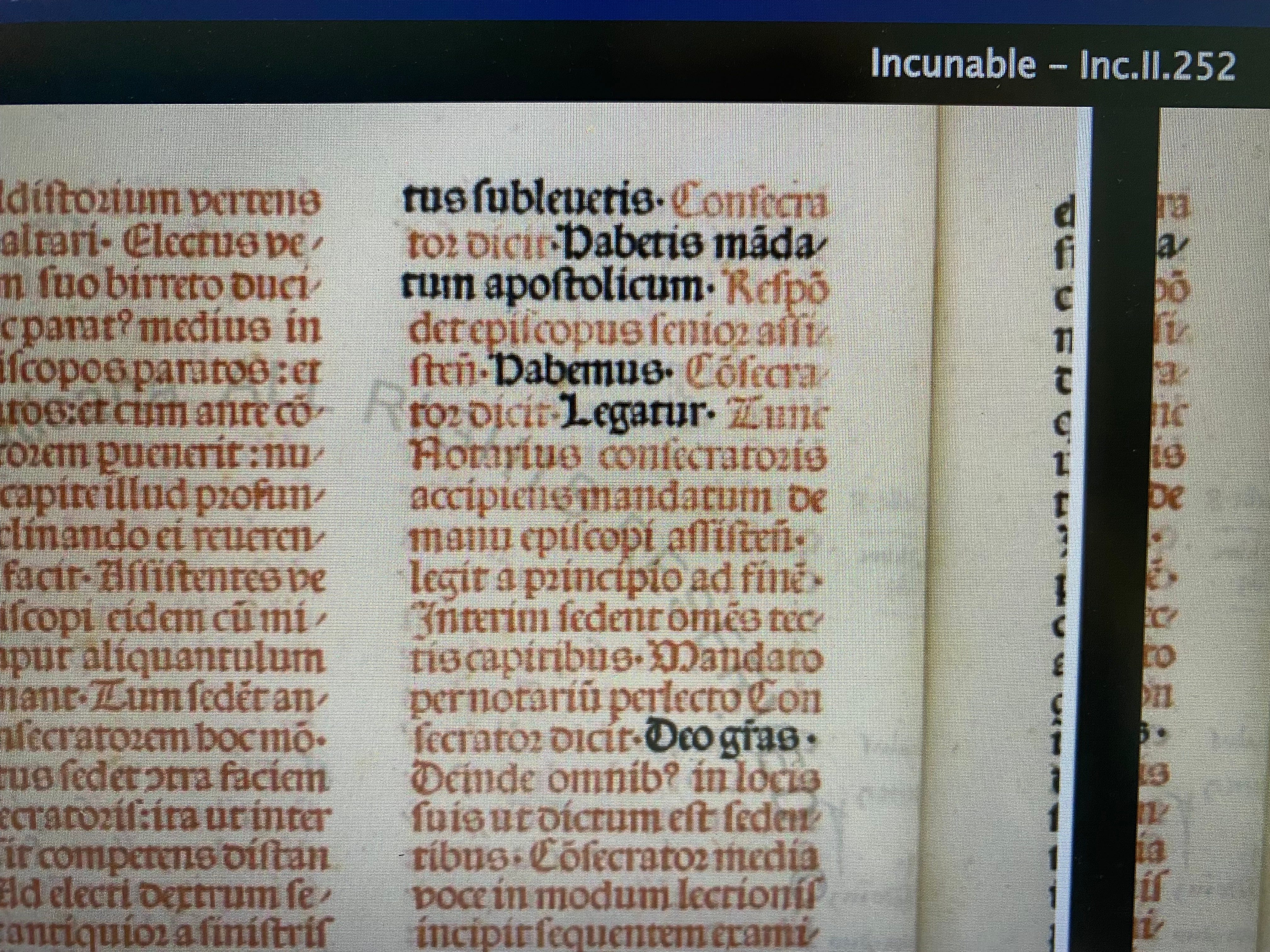
A crucial part of this argument is that the Apostolic Mandate is required - and thus printed and explained in great detail in red rubrics - in the original print of the Roman Pontifical, the so-called Piccolomini-Patrizi editions. The text of episcopal consecrations - especially those initial three lines, with the question, “do you [presumably three bishops - SSPX only had two, at each illicit consecration] have the Apostolic Mandate?” - “We do have [it].” - “Let it be read”. Those can be read just as they are now, from the first printed edition : see 33v to 35v at https://digi.vatlib.it/view/Inc.II.252
I make bold to emphasize this fact, because it is now common in “learned” trad-circles to stress that “this changed” in the 1983 Code…or those who are somewhat more honest and learned may admit: this changed in 1958, i.e., in Pope Pius XII’s encyclical Ad Apostolorum Principis, against the works and words of the People’s Republic of China. Now, given that I have heard the whataboutist complaint about supposed Roman inaction, in the face of the Chinese Communist Party’s “choice of bishops” - which is a lie and gross oversimplification of the recent reunion of the Patriotic Chinese Church and the Underground Church, the import of this encyclical should be great! Instead, it seems that the same folks who would excuse the SSPX from any error would also like to use current Chinese compliance as a simultaneous argument against Rome’s Orthodoxy! This is not an exaggeration, and if you have even wondered aloud about the legitimacy of the SSPX’s actions on July 1, you would have surely heard some lament about how Rome allows the “Chinese Communist Church” to choose bishops, tout court. Again and again: this is a lie in each instance. The CCC does not choose bishops: it proposes, Rome disposes. Not even Cardinal Zen claims this - and he would know. And, how would following the CCC’s actions in the 50s excuse the SSPX in the 2020s?
Finally, we consider Canon 2370 of the 1917 Code. Consecration without an Apostolic Mandate may not have latae sententiae IPSO IURE excommunication as its penalty, but it is a suspension, reserved to the Apostolic See - and there are few crimes more seriously punished in the 1917 Code!
Would many dare to do what Lefebvre did? He lied when he said “habemus” [= have the apostolic mandate]; at the “legatur”, he pretended to read what would always be read as an apostolic mandate at that point in the liturgy. Instead, he read something of his own creation. On July 1, 2026, the SSPX followed that fabrication of reading a look-alike non-mandate at the point when “legatur” would have normally been read - but they chose not to read those words and to substitute - again - a non-mandate of their own composition, unrolled as a scroll, which is how these mandates are made. As if that fabrication and that omission were not bad enough, the SSPX omitted the words “habemus” too, in contradiction to Lefebvre’s fabrication.
No one in the SSPX has said publicly why the SSPX did differently (and against the explicit rubrics and black text of the Traditional Roman Pontifical); they went down a different path that Lefebvre. Lefebvre never received a mandate for any particular priest (which is what the first question asks), but at least he had been told that he would receive one - granted, not the three that he originally requested, nor the two that he later demanded from Card. Ratzinger - but at least he had been told provisionally that for one man he would receive this (and, yes, Ratzinger had agreed to ask JP II about a second).
To restate what we’ve shown: the demand, the necessity of an apostolic mandate and mission comes from the Council of Jerusalem, and even before Nicaea, the Popes judged the legitimacy of other bishops - even bishops from Sees that had been established and even held by Apostles!
Also, in response to later “canonical complaints” made by the SSPX and those who can find anything and everything wrong with Roman responses but nothing wrong with SSPX arguments: you should know that Roman legates - men sent by the Pope to judge in his name - have been used since at least the 2nd century, and was used most famously in the first millennium’s Councils (if one excepts the odd kidnapping before the Fifth Council).
I confess: I don’t expect this evidence to convince anyone who is not already convinced. I simply offer it as a presentation of what should be known and what should be confronted before one excuses a single act of the SSPX - much less that grave act that was carried out on July 1. Apologists, explicit and implicit, will simply ignore this bimillennial Tradition…to support other traditions. You might read St. Matthew’s Gospel 7:13 in this regard.
Two wrongs never make a right, as the common-sense saying goes; but I have never seen the SSPX pronounce any sort of “mea culpa”, from 1974-2026. And the individuals who remained with them for decades, but decided to return to the bimillennial Tradition and to the didascalia/magisterium, which St. Irenaeus mentions in Book Three of Adversus Haereses? They are called unpronounceable names by those who remain *attached to the SSXP*.
Speaking of “attached”, next time we’ll take a look at the long-standing usage of “adherence” / “attachment” - to a schism, in 2000 years of Church documents about Church unity. Spoiler alert: it isn’t a “novel” term, as many would like you to believe!
Stay tuned.